One Health (including food-borne pathogens)
One Health is an integrated approach that recognizes the interconnectedness of human, animal, and environmental health to effectively prevent and manage global health challenges.
STAR IDAZ Approach
One Health recognises the interconnections between the health of humans, animals, plants and the environment, and the value of collaborative and interdisciplinary approaches to addressing complex health challenges. As an international consortium focused on animal health research coordination, STAR IDAZ promotes consideration of One Health approaches where these can strengthen research and disease control.
STAR IDAZ has undertaken dedicated work on the funding and coordination of research using a One Health approach, producing a series of reports exploring the global funding landscape, barriers to effective funding and practical opportunities to improve research coordination.
Information
-
One Health Commission - One Health Tools and Toolkits
These documents aid in health systems management, disease surveillance, research, learning, and much more. To help streamline awareness of and access to them, the One Health Commission has gathered tools and toolkits from across the web and presented them.
Working group
One Health Working Group
The STAR IDAZ One Health Working Group was established to explore how research funders could better support and integrate One Health approaches. Working with experts from across animal, human, plant and environmental health and the social sciences, the group examined the global One Health research funding landscape and identified opportunities to improve coordination and funding mechanisms.
The dedicated One Health Working Group is no longer active, having completed its programme of work. Its findings and recommendations remain available through the STAR IDAZ One Health reports and continue to inform the consortium's wider approach to research coordination.

Key People

Aurelie Castinel,
SAFOSO Switzerland

Baldissera Giovani,
Euphresco France

Bassirou Bonfoh,
Swiss Centre of Scientific Research Côte d'Ivoire
Benjamin Roche,
Research Institute for Development (IRD) France

Chadia Wannous,
World Organisation for Animal Health (WOAH) Global
Diana Rojas Alvarez,
WHO Emergencies Programme Switzerland

Dirk Pfeiffer,
City University of Hong Kong China

Fabian Leendertz,
Helmholtz Institute for One Health Germany

Gabriela Di Giulio,
University of São Paulo Brazil
Jakob Zinsstag,
Swiss Tropical and Public Health Institute Switzerland

Joanne Webster,
Royal Veterinary College and Imperial College of London United Kingdom

Jonna Mazet,
University of California United States
Kris Murray,
London School of Hygiene and Tropical Medicine United Kingdom

Linfa Wang,
Duke NUS Medical School Singapore
Malik Peris ,
University of Hong Kong China
Marc Johnson,
University of Missouri United States
Mariella Marzano,
Forest Research United Kingdom

Misheck Mulumba,
ARC Onderstepoort Veterinary Research South Africa
Muriel Vayssier-Taussat ,
INRAE France

Nigel French,
Massey University New Zealand
Paul Pronyk,
SingHealth Duke-NUS Global Health Institute Singapore
Paula Prist,
Ecohealth Alliance United States

Paulo Vela,
Cayetano Heredia Peruvian University Peru

Robyn Alders,
Australian National University, Australia Australia

Salazy Bin Abubakar ,
University of Malaysia Malaysia
Sascha Knauf,
Friedrich-Loeffler-Institute (FLI) Germany
Tony Barnett,
London School of Hygiene and Tropical Medicine United Kingdom
Wanda Markotter,
University of Pretoria South Africa

Zelalem Tadesse,
Food and Agriculture Organisation (FAO) Italy
Featured
EU Aquaculture Assistance Mechanism
The EU financially supports the aquaculture sector with a wide range of funding programmes, mainly implemented through…
Reports
Reports and outcomes from meetings and workshops

Research roadmaps and gap analyses
Gap analysis summary
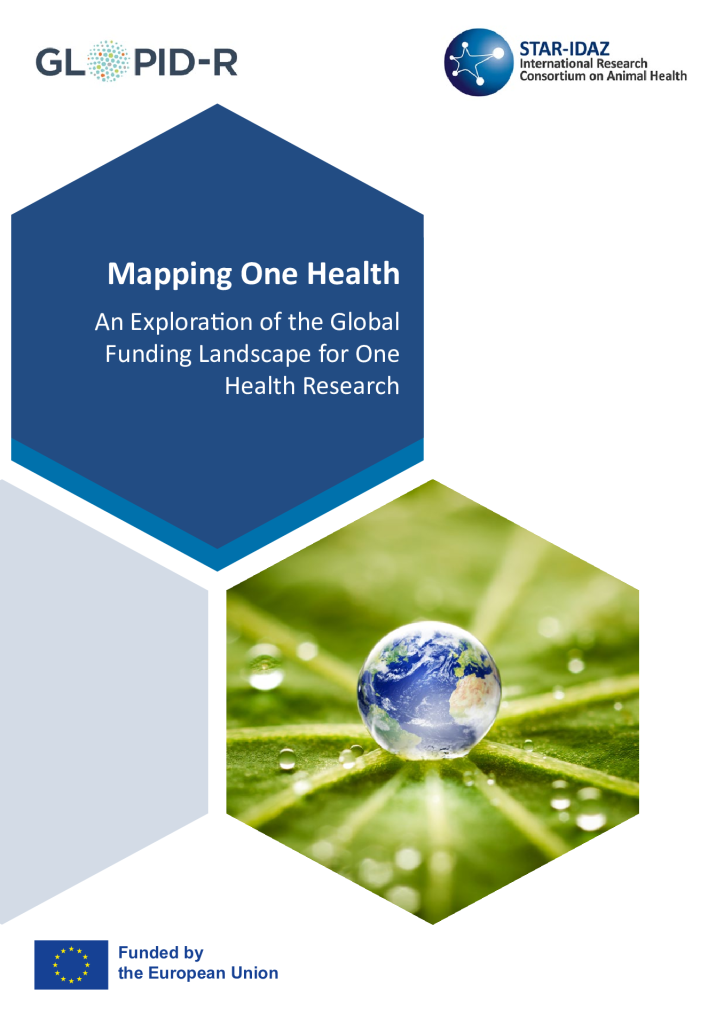
STAR IDAZ’s One Health work has focused particularly on improving the funding and coordination of research that uses integrated One Health approaches. The programme examined the global funding landscape, barriers to effective funding and opportunities to improve coordination between researchers, funders and other stakeholders. It highlighted challenges including fragmented governance and funding, short funding timeframes, limited flexibility and sustainability, and barriers to equitable participation. Recommendations include greater coordination between funders, longer-term and more flexible funding, co-creation of research, improved communication and greater consideration of sustainable financing mechanisms.
Projects
Displaying 4 of 28 projects
VIEW ALL PROJECTSEU-JAMRAI 2 – Joint Action Antimicrobial Resistance and Health-care Associated Infections
Planned Completion date 31/12/2027
United Kingdom
IntelliRAS – Intelligent farming and health control in landbased recirculating aquaculture systems
Planned Completion date 01/09/2024
United Kingdom
Fish for Development in Ghana – Aquaculture
Planned Completion date 31/12/2024
United Kingdom
Phage-Driven Health: Undersøkelse av potensialet for å bruke bakteriofager i kampen mot patogener for å forbedre dyrehelsen og dyrevelferden i fjørfe
Planned Completion date 31/12/2025
United Kingdom
Recent publications
Reports and outcomes from meetings and workshops

Foodborne disease burden in Sweden with a One Health perspective
One health, One crisis: Tackling India's alarming burden of food-borne pathogens and antimicrobial resistance at the human-animal interface
Fascioliasis and anisakidosis highlight the need for integrated One Health approaches to food safety and security
The efficacy of plant extracts against key food-borne pathogens: A mechanistic, applications, and advances